Para penulis
Rifa Rifqiyatun Nisa, Quine Disti Atakita, Indira Faydzatun Nufus, Afni Regita Cahyani Muis
rifarifqiyatun@gmail.com,quinedisti@gmail.com,faydzatunindira@gmail.com,afniregitacahyanimuis@unida.gontor.ac.id.
University of Darussalam Gontor

ABSTRACT
The issue of harmonizing halal standards is becoming increasingly important as international trade in halal products increases. Indonesia, as a predominantly Muslim country, faces challenges due to the lack of uniform global halal standards. This fragmentation creates non-tariff barriers, particularly for halal products from the MSME sector, which frequently require re-certification in export destination countries. This study aims to analyze Indonesia’s strategy in addressing these challenges through international cooperation in the form of a Mutual Recognition Agreement (MRA) between the Halal Product Assurance Agency (BPJPH) and foreign halal certification institutions. The approach used is descriptive qualitative, with perspectives from economic diplomacy and international cooperation theory, through analysis of documents and policy data. The study results indicate that the MRA is a crucial instrument in expanding recognition of Indonesian halal certification and strengthening the export competitiveness of halal products. Furthermore, this collaboration also contributes to the capacity building of national halal institutions through competency enhancement, knowledge transfer, and strengthening international networks. Overall, these efforts demonstrate Indonesia’s shift from a recipient of standards to an actor contributing to the formation of inclusive and credible global halal governance.
Keywords: Mutual Recognition Agreement, Halal Standardization, BPJPH, Capacity Building
Introduction
Global halal standardization is a phenomenon that has been affecting the dynamics of international trade in the past decade. Increased supply and demand Halal products globally indicate that halal products have good quality value. Initially, halal products were solely related to adherence to religious values, but now halal products are in demand because of quality, safety, cleanliness and even sustainability. (Alfarizi, 2022) Halal products are now seen as a symbol of quality and ethics of modern production, not only by Muslim consumers, but also by non-Muslim communities in various countries.
Therefore, many countries, both members of the Organization of Islamic Cooperation (OIC) and non-OIC countries such as South Korea, Australia, Italy and so on, are trying to ensure the quality of halal products by developing their own national halal certification systems. However, this effort actually causes the global halal system to develop rapidly but not uniformly, due to differences in principles, regulations, and implementing institutions in each country.
The situation of global standard inequality creates complex issues in international trade. This happens because, each country has halal standards with different criteria. On the one hand, countries are competing to strengthen their halal regulations and certification bodies to meet the needs of domestic consumers and expand export market share, but on the other hand, the disharmony between national halal standards leads to fragmentation that has a direct impact on the smooth flow of international trade. Halal products that have been certified in one country will not necessarily be recognized by another, thus creating non-tariff barriers in the form of recertification of additional costs, and complex cross-border bureaucracy. This condition ultimately hinders the turnover of halal products in the destination country.
However, in practice, Indonesia still faces a number of very serious challenges in the development of the national and global halal system. One of the main challenges comes from the entry of halal imported products from non-OIC countries such as Japan, Australia, Italy, and South Korea, which often have different certification systems and quality standards that are not necessarily in accordance with sharia principles as set in Indonesia itself.
In this context, Indonesia has a strategic position as well as a great responsibility. As a country with the largest Muslim population in the world, Indonesia has enormous halal economic potential, both in terms of production, consumption, and innovation. Based on data Global Islamic Economy Report By 2024, Indonesia will be among the top five countries with the largest halal export contribution in the world. However, this contribution is still relatively small globally, only up to about 3-4%. (Hakim, 2024) This condition shows that there is a gap between Indonesia’s great potential and the realization of halal exports that are still limited. One of the main causes is the limited recognition of national halal standards at the international level.
On the other hand, this challenge also opens up space for reflection for Indonesia to strengthen the quality and quality of domestic halal products. (Muhnidin, 2024) In the face of the dominance of imported products from non-OIC countries, Indonesia needs to improve certification, supervision, and innovation standards so that its products can compete in the international halal market. This effort must be carried out in conjunction with cross-border halal diplomacy, because without international recognition, even the quality of the product is not enough to open market access. (Halal B. P., BPJPH.halal, 2025)
In response to these challenges, the Indonesian government established the Halal Product Assurance Agency (BPJPH) as an authoritative institution tasked with regulating, fostering and developing the national halal product assurance system. However, the function of BPJPH does not stop at the domestic level. (Silmi, 2025) In the global context, BPJPH also plays an important diplomatic role through international cooperation in the field of halal standardization.
This effort is realized by collaborating with foreign halal certification institutions, both in forming the signing of a Memorandum of Understanding (MoU) and Mutual Recognition Agreement (MRA) as the main instrument to achieve halal certification recognition between countries so that Indonesian halal products can be accepted abroad without a recertification process that burdens business actors.
Indonesia’s involvement in global halal cooperation is not only driven by economic interests, but also by its mission to contribute to the establishment of fair and inclusive international halal governance. In forums such as Standards and Metrology Institute for Islamic Countries (SMIIC), Indonesia actively encourages the harmonization of global halal standards by carrying out the principles of equality and mutual recognition between countries.
These products, especially from Europe, America, and Japan already dominate most of the world’s halal market due to their more advanced branding and production technology. (Ilham, 2025) Meanwhile, many Indonesian MSMEs are left behind due to cost constraints, certification, technological limitations, and the lack of national recognition of their halal certification. As a result, Indonesian halal products are often considered less competitive in the global market.
On the other hand, this challenge also opens up space for reflection for Indonesia to strengthen the quality and quality of domestic halal products. (Muhnidin, 2024) In the face of the dominance of imported products from non-OIC countries, Indonesia needs to improve certification, supervision, and innovation standards so that its products can compete in the international halal market. This effort must be carried out in conjunction with cross-border halal diplomacy, because without international recognition, even the quality of the product is not enough to open market access. (Halal B. P., BPJPH.halal, 2025)
Through the role of BPJPH and MRA’s cooperation with foreign halal institutions, Indonesia is trying not only to adapt to the global system, but also to become a major actor in shaping it. This study sees that international cooperation in the field of halal standardization is not only a technical need, but also a representation of Indonesia’s economic diplomacy strategy in strengthening its position among the world’s main halal producing countries.
So, the formulation of the problem we raised is as follows. What is the strategy for developing halal standardization cooperation within the framework of the Mutual Recognition Agreement (MRA) between Indonesia and Foreign Halal Institutions? And the purpose of the research is to analyze and explain the dynamics of international cooperation in the development of halal standardization between Indonesia through BPJPH and foreign halal certification bodies within a framework, namely the Mutual Recognition Agreement (MRA). Academically, this research contributes to enriching International Relations in the field of international cooperation and global governance by raising a concrete case of halal cooperation that presents the relationship between religious values and national economic interests.
Literature Review
Mutual Recognition Agreements (MRA) has proven to play an important role in expanding global market access for Indonesian halal products, especially in the agro-food sector. With the largest Muslim population in the world, Indonesia faces challenges in setting mandatory halal standards through national certification mechanisms, which has an impact on competition with imported halal products. MRA opens up opportunities for Indonesia’s halal business expansion into the international market, but also demands a comprehensive strategy that includes strengthening standards, financial support for MSMEs, and quality management to maintain the competitiveness and sustainability of the industry. (Azizah, 2025)
The challenge of harmonizing global halal standards is also a major concern, especially in the context of Indonesia’s halal food exports to member countries of the Organization of Islamic Cooperation (OIC). Standard (Standards and Metrology Institute for Islamic Countries) The SMIIC initiated by the OIC is voluntary and has not been widely adopted by all member countries, thus hindering the creation of a universal halal standard. To address this, Indonesia is using the MRA mechanism as a bridge between global and local standards, which has managed to increase the number of deals from eight in 2022 to 92 in 2024. This strategy became an effective policy model, allowing Indonesia to strengthen economic ties with other Muslim countries and affirming the important role of localizing international norms in expanding the halal export market. (Fathoni, 2024)
On the other hand, various halal standards are developed nationally by several countries, such as Malaysia, Indonesia, Singapore, as well as regional organizations such as SMIIC representing OIC member countries. Although these standards share fundamental similarities rooted in the sources of Islamic law, namely the Quran and Al-Hadith, and aim to meet the needs of global Muslim consumers, differences in implementation remain a challenge. (Abdullah, 2021) The disharmony of halal certification standards leads to fragmented supply chain practices and increased costs for producers and exporters. Therefore, the integrity of the halal supply chain is a major concern, especially related to the integration of different halal certification standards in various countries. (Aufi, 2024)
Efforts to harmonize halal standards through the establishment of uniform standards and certifications at the OIC level are very important to strengthen the halal industry and facilitate access to halal products between countries. However, the main difficulty is the difference in the views of each country’s sect and sovereignty that makes it difficult to reach a global agreement. Some OIC countries, such as Malaysia, Indonesia, and Jordan, have developed nationally recognized halal standards and certification bodies, but the global harmonization process still requires more intensive cooperation. (Halim, 2012)
Overall, the existing literature has confirmed the crucial role of MRAs and the challenge of harmonizing global halal standards, but the main focus tends to be concentrated on efforts among OIC member states or Muslim majority. This opens a gap for further research, where this research will discuss opportunities for cooperation in the development of halal standards within the framework of MRA with non-Muslim countries. Therefore, this article focuses on opening up global market access by bridging the differences in halal standards between Indonesia and non-Muslim countries, as part of Indonesia’s halal expansion strategy in a broader context. This is important because it opens up great opportunities and new complexities in the recognition and development of inclusive and universal global halal standards.
Methods
This study uses a qualitative approach with an analytical descriptive method because it aims to understand in depth the dynamics of international cooperation carried out by Indonesia through the BPJPH Halal Product Assurance Agency in the form of an MRA framework with foreign halal certification bodies. This type of research is descriptive in nature that focuses on efforts to describe the phenomenon of cross-border halal cooperation, explain the motives and strategies of economic diplomacy carried out by Indonesia, and analyze its implications for the recognition of global halal standards.
Meanwhile, this study uses secondary data collected from various academic literature, international cooperation documents published by official institutions, as well as international and national journal articles and research reports relevant to the topic discussed. (Team, 2025) And the data collection technique is carried out through library research and analyzing documentation, namely by reviewing official BPJPH documents, international cooperation reports, the results of global halal conferences, as well as data from organizations such as SMIIC and the Global Islamic Economy Report.
With this method, the research is expected to be able to provide a comprehensive picture of Indonesia’s strategic position in halal diplomacy, assess the effectiveness of MRA cooperation in expanding national halal certification recognition, and provide policy recommendations that can strengthen BPJPH’s role in realizing the harmonization of inclusive and mutually beneficial global halal standards.
A. International Cooperation
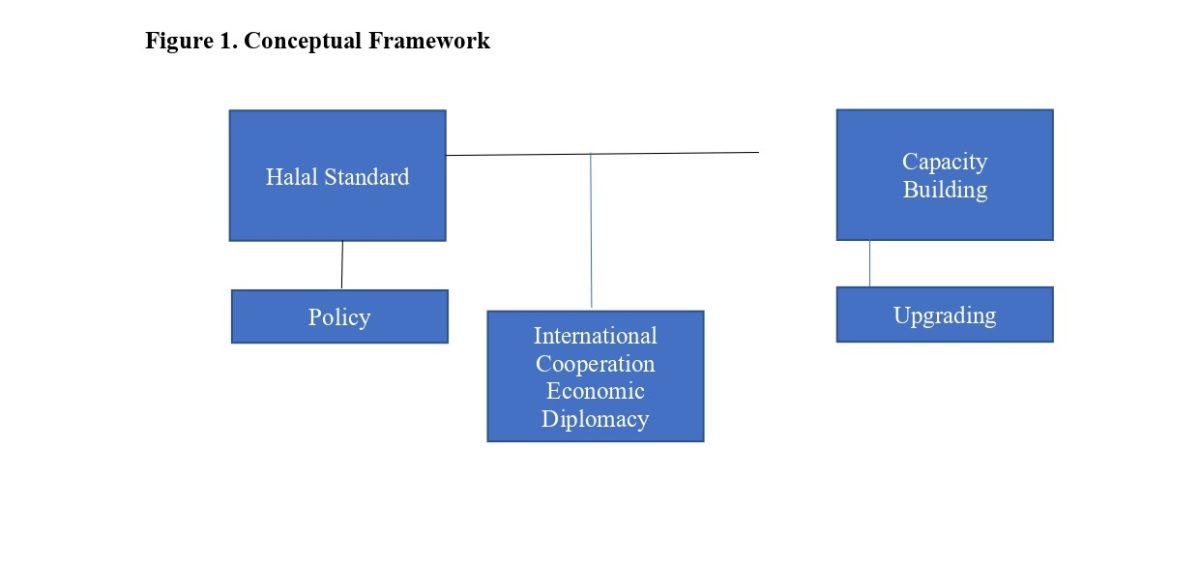
Cooperation in the development of halal standardization within the framework of the MRA Mutual Recognition Agreement between Indonesia and foreign halal institutions is a concrete step from the application of the concept of international cooperation, and economic diplomacy at the same time. In the context of international relations, this cooperation reflects collaboration between countries that is oriented towards common interests, namely strengthening the global halal certification system to facilitate cross-border halal product trade.
According to Robert Keohane, international cooperation arises when countries are willing to adjust their policies to achieve mutually beneficial outcomes under a framework of common rules. (Team, 2025) Through the cooperation of MRA, Indonesia and partner countries such as Malaysia, Singapore, the United Arab Emirates, or OIC member countries, agreed to recognize each other’s halal certification validity. (Gumanti, 2025) This agreement not only suppresses technical barriers to trade, but also strengthens trust between countries in the halal product assurance system. This is in line with Kegley and Witkopf’s view that international cooperation can promote global stability and prosperity through coordination of interests and increased economic interdependence.
International cooperation is usually very dominant with the encouragement of mutual interests or common interest. In this context, the common interest in question is the need to create a global halal standard system that is harmonized and internationally recognized (Firdaus, 2025) so as to facilitate the flow of trade in halal products across countries and strengthen the trust of Muslim consumers around the world. Indonesia’s cooperation with foreign halal institutions through MRA can be seen as a form of international cooperation in the field of economics and technical regulations.
According to Bayne and Woolcock, economic diplomacy is the use of economic resources such as trade, investment, and cooperation between countries as a tool to achieve foreign policy goals. In this context, cooperation in the development of halal standardization through MRA reflects the tangible form of Indonesia’s economic diplomacy. Through the BPJPH Institute, Indonesia collaborates with various countries, such as Malaysia, South Korea, Australia, and the United Arab Emirates, to expand national halal certification recognition. This effort not only smoothens the trade flow of halal products, but also strengthens Indonesia’s position in global economic diplomacy as a country that plays an active role in shaping mutually beneficial international halal standards. (Bayne N, 2011)
International cooperation is understood as Indonesia’s strategic mechanism to build global legitimacy and trust in the halal certification system through the process of diplomacy, harmonization, and joint capacity building. (Harahap, 2024) Through this approach, Indonesia not only becomes a participant in the global halal order, but also becomes a normative actor that helps determine the direction of the development of fair and mutually beneficial international halal standards.
B. Capacity Building
Concept Capacity Building It can be understood as a process of increasing institutional capacity, but it can also include upgrading human resource capabilities, technological innovations, and work systems that support the sustainability of an organization or country. (Atanabe, 1998) According to the OECD capacity building It is a planned effort to develop the ability of individuals, organizations, and systems to carry out important functions effectively, efficiently, and sustainably.
In the context of the halal economy, this concept is very important because the challenges of globalization, digitalization, and harmonization of international standards require increased competition for workers and the adoption of technology that is able to support fast, accurate, and reliable halal certification. In this study, capaicity building is understood as a process of improving the ability and professionalism of workers in the halal sector, both auditors, halal providers, and MSME actors themselves.
Capacity building It is also a capacity building that only occurs at the institutional or technical level, but also in shaping the development of work culture and professionalism of halal human resources. In terms of technology capacity building is a key factor to ensure that the national halal system is able to adapt to global digital developments. This technology also supports transparency, accountability, and data integration between BPJPH and foreign institutions that are MRA’s partners. (Viartasiwi, 2024) Thus capacity building play a role in strengthening the structural competitiveness of Indonesia’s halal industry through a combination of human capacity building and technological innovation.
Concept capacity building In this study, it is understood as a strategy to strengthen national capacity through improving the quality of human resources, institutions, and halal technology. This process is an integral part of Indonesia’s halal diplomacy, because through international cooperation, the country not only gets certification recognition, but also reaps long-term benefits in the form of system modernization, increased workforce skills, and strengthening Indonesia’s position in the global halal regime
Discussion
2.1. Halal Regime within the Framework of the Mutual Recognition Agreement (MRA)
The phenomenon of increasing trade in halal products at the global level has given birth to the need for an international halal regime that can regulate, supervise, and harmonize various kinds of halal certification standards between countries. (Urus, 2025) In the context of Govermence studies or regime terms here, it refers to the uniformity of norms, rules, and procedures of each country that have been mutually agreed upon by various actors, both countries, international institutions, and halal certification institutions to regulate certain issues, in this case certification and trade of halal products across national borders.
This halal regime does not stand under a single organization like the WTO, but develops multilevel and fragmented, because each country has a different legal basis, religious authority and sharia approach. (Wibowo, 2024) This condition creates a big challenge in international trade, because products that have received halal certification from one country are not necessarily recognized by other countries. Because many business actors, especially MSMEs, have to carry out a double certification process which not only costs a lot but also slows down export access and hinders the efficiency of the global halal supply chain.
To answer this problem, various Muslim countries then encouraged the establishment of the MRA mechanism as an instrument of cooperation between halal institutions around the world. MRA is a form of agreement between two or more parties to recognize the results of certifications or standards that have been enforced in each country. In the context of halal, MRA means that products that have obtained a halal certificate from a recognized institution in one country, are automatically recognized as halal in another country that is a cooperation partner. With this mechanism, non-tariff barriers can be reduced, the cost of repeated certification can be reduced and the movement of halal products across borders becomes more efficient.
In practice, MRA is also an arena for economic diplomacy and value politics negotiation. (Islam, 2023) Halal standards are not just a technical issue, but also concern the authority of interpreting Islamic law, food quality control, and the trust of global Muslim consumers. Countries such as Malaysia, Indonesia, and the United Arab Emirates are competing to assert their position as global halal hubs with their respective halal certification systems. This is where the role of the MRA becomes an important instrument in building a more inclusive regime, as it paves the way for mutual recognition and the establishment of common standards that prioritize principles Unity in Diversity in sharia. Unity in Diversity Here the point is the principle of unity in diversity, so that despite differences in ethnicity, religion, culture and outlook on life, we can still live in harmony and unite as a unit.
Organizations such as Standards and Metrology for Islamic Countries (SMIIC) under the auspices of Organizations Islamic Coorporation (OIC) plays an important role in encouraging the harmonization of international halal standards. SMIIC functions as a technical forum to prepare halal guidelines and codes of ethics that can be used as a global reference. However, the success of harmonization depends heavily on the commitment of each country to build a unity in recognition that is realized through MRA. (Akbar, 2023) In this context, Indonesia through BPPJPH is trying to become an active part of the global halal regime by utilizing MRA as an entry point for diplomacy and standardization.
Thus, the halal regime within the framework of MRA is not only a matter of administration or certification but also a form of soft power diplomacy that describes the interaction between Muslim and non-Muslim countries in determining the legitimacy of global halal norms. Indonesia, through MRA, seeks to assert itself not only as a recipient of standards, but as a normative actor who participates in formulating and influencing the direction of world direction.
2.2 Cooperation in the development of Indonesian halal standardization with foreign halal institutions within the framework of the MRA Mutual Recognition Agreement
Cooperation in the development of halal standardization between Indonesia and Foreign Halal Institutions (LHLN) such as Australia, South Korea, Italy, and Japan within the framework of Mutual Recognition Agreement (MRA) (Liu, 2010) is a tangible manifestation of Indonesia’s halal economic diplomacy which is increasingly strategic and multidimensional. Through BPJPH, Indonesia not only seeks to expand its halal certification standards, but also fights for regulatory sovereignty in the global halal system which has tended to be dominated by certain countries such as Malaysia, and the United Arab Emirates.
In the implementation of halal diplomacy through the MRA Mutual Recognition Agreement cooperation, Indonesia faces various challenges as well as strategic opportunities. The main challenge lies in the fragmentation of global halal standards. Each country has a different regulatory certification system, and halal institutions, so there is no uniformity of procedures or criteria that apply internationally. Halal certification that has been issued by BPJPH domestically is often not recognized in export destination countries due to differences in certification authorities and methodologies.
In addition, institutional and technical challenges are also important factors even though BPJPH has made efforts to build a strong national halal certification system, there are still limitations in terms of the number of internationally certified halal auditors, testing laboratory capacity, and digitalization systems that have not been fully integrated with foreign institutions. On the other hand, several partner countries such as Malaysia, the United Arab Emirates, and Australia already have well-established and widely recognized halal systems. This makes Indonesia’s bargaining position in cooperation negotiations a balance point in the early stages.
The cooperation built by Indonesia with non-OIC countries on the standardization of halal products must have a reason. In this case, Australia is the country with halal red meat exporters to Muslim countries. This is because Australia has beef and lamb with excellent quality, so that supply and demand in Indonesia increase. Another reason is to support the free nutritious eating (MBG) program. In this case, halal standardization is needed between Indonesia and Australia to equalize the halal label on red meat imports from Australia. Likewise, Australia needs to import halal products from Indonesia because the supply and demand related to halal products in Australia increases because halal products ensure quality and safety. (CNN Indonesia, 2025)
In addition to Australia, cooperation with Japan has a different focus, namely halal development in the tourism and culinary sectors. Japan is strengthening its policy with Muslim-Friendly destinations, ahead of the World Expo Osaka in 2025. BPJPH has established a partnership with Japan Halal Association JHA, Nippon Asia Halal Association NAHA, and several regional halal authorities to Compile halal certification guidelines for restaurants and hotels in Japan. (Halal B. P., Badan Penyelenggara Jaminan Produk Halal, 2023) In addition, Indonesia also provides technical support through training of halal providers and the preparation of income standards adapted to the Japanese context. This form of cooperation is a symbol of cultural and economic cooperation, where Indonesia plays a role as a media partner of non-Muslim countries in building a halal ecosystem.
In addition to these two countries, there is Italy which is an important partner in the European Region. BPJPH is collaborating with the Italian halal institution and the European Institute of Halal Certification EIHC to expand the recognition of Indonesian halal certification in the European Union region which is strict on food safety. (ANTARA, 2025) The main focus of this collaboration is the exchange of regulative information, halal laboratory training, as well as the establishment of verification mechanisms to strengthen trust between halal certification bodies in Europe and Asia. Through this cooperation, Indonesia expands its halal diplomacy to secular areas that have great potential, while displaying the image of moderate and professional Islam.
Indonesia also relies on imported products related to medicinal products from non-Muslim countries, the majority of which come from Europe. This is one of the factors for standardizing halal products between non-OIC countries. The amount of drug imports is about 95% of the total materials for the production of synthetic drugs. Because of this, the certainty of the halal label must be questioned. (Arif, 2020) So the need for halal standardization not only between Muslim countries but also between non-Muslim countries is also very important because of the high supply and demang of it.
This collaboration is in accordance with Article 122 GR 39 of 2021, where this article is in the form of mutual recognition of halal certificates carried out with LHLN which has the authority to issue halal certificates. The requirements that must be met by LHLN to cooperate with BPJPH are, (1) Organizational Structure, (2) List of Sharia Councils, (3) List of Halal Auditors and their Biography, (4) Scope of Halal Product Inspection based on Competence and Assessment of Halal Conformity Accreditation, (5) Proof of local State Recognition of the existence of Halal Institutions, (6) Proof of local State Recognition as Islamic Religious Institutions, (7) Evidence of Halal Institution’s cooperation experience with various countries or institution, (8) Proof of Halal Certificate issued and still valid, (9) Proof of Accreditation from the National Standards Agency and (10) Proof of having a Cooperation Laboratory. (Kementerian Agama Republik Indonesia, 2021)
They have the advantage of being a pioneer, which is a better position because they built an international reputation and network in halal certification earlier. As a result, many other countries including Indonesia have had to adapt to the standards and recognition frameworks they have created. This situation indirectly puts Indonesia in a subordinate position to the lowest position in global governance. Therefore, MRA cooperation is Indonesia’s diplomatic strategy to balance the power structure through the establishment of a more equal and inclusive network of mutual recognition.
In practice, this cooperation covers various aspects, namely the harmonization of halal standards, strengthening the capacity of halal auditors, digitizing the certification system and regulating informative exchange. For example, BPJPH collaborates with the halal institution system such as Malaysia, Thailand, and Sri Lanka to develop a certification that can be recognized across jurisdictions. (Elmeri, 2025) In 2023, BPJPH will also sign a series of MRAs with dozens of foreign halal institutions, including institutions from Korea, namely Korea Muslim Federation which was announced in the framework of Halal World 2023. (Halal B. , 2023) Through forums such as SMIIC, and the World Halal Council Indonesia play an active role in encouraging the preparation of international halal regulations.
From the perspective of global political economy, halal cooperation within the framework of the MRA can be seen as a form of normative diplomacy that depends between economic interests and Islamic spirituality. (BPJPH, 2024) Countries are trying to monstify the halal symbol as a instrument branding nasional and soft power not just sharia care. So that the development of halal standardization has the potential to be trapped in the logic of the global market, where the halal label becomes a commodity label, not a moral value. This is a critical challenge for Indonesia to maintain sharia authenticity amid the pressure of international harmonization that tends to be technocratic.
Thus, cooperation in the development of halal standardization within the framework of MRA is not only an economic instrument, but also a normative political project and national identity, Indonesia is trying to construct its new role as an entrepreneurial norm, namely a country that not only adjusts to the existing halal regime, but also redefines the meaning and direction of global halal standardization. Through an adaptive and capacity-building diplomacy strategy, Indonesia is slowly building a more advanced halal regime, where justice, belief, and Islamic values can be balanced with the interests of international trade.
Conclusion
Cooperation in the development of halal standardization within the framework of the Mutual Recognition Agreement (MRA) between Indonesia and foreign halal institutions is not only a matter of technical certification, but also a form of economic diplomacy that reflects Indonesia’s efforts to strengthen its position in the midst of the fragmentation of global halal standards. Through BPJPH, Indonesia is trying to expand the recognition of national halal certification, especially to help MSMEs that have been struggling to penetrate the international market because they have to undergo expensive and complicated recertification. This effort proves Indonesia’s role from a passive recipient of halal standards to an actor who helps determine the direction of global policy.
However, MRA does not immediately guarantee success. Many agreements that have been signed actually end up as symbols, if not accompanied by strengthening domestic capacity. Without competent human resources, adequate halal laboratories, integrated digital systems, and strict supervision, Indonesia’s halal certification will still be seen as less convincing by international partners. In practice, MRA is only really effective if it is supported by a strong national halal product assurance system from within.
On the other hand, this cooperation also opens upopportunities capacity building. Through knowledge exchange, training, and technical collaboration with both Muslim-majority and non-Muslim countries, Indonesia can improve its halal institutions. Forums such as SMIIC and hosting Indonesia International Halal Festival (IIHF) is an important forum to build networks and introduce Indonesian halal standards to the world. Of course, this must also be balanced with strong negotiation skills so that Indonesia is not only a party that adjusts, but also determines the rules of the game.
The challenges faced such as the dominance of Malaysia, the United Arab Emirates, and non-OIC countries in the global halal market require Indonesia to act faster so that it does not just become a follower. On the other hand, the commodification of halal labels risks shifting sharia values to mere barnding strategies. Therefore, the success of MRA is not enough to measure only the number of exports or cooperation partners, but also from Indonesia’s ability to maintain the authenticity of halal while building a fair and reliable global halal governance. MRA is the beginning to ensure that halal cooperation really provides real benefits for MSMEs, the world’s Muslim consumers, and Indonesia’s position as a global halal center.
Author Contributions
Rifa, as the author of the introduction and the second discussion. Quine, as a writing systematic, literature review writer, and second discussion enhancer. Indira as the author of the first discussion, and conclusion. Afni, Monitor the writing of papers, assist in the design of conceptual frameworks, and research methods of analysis flows.
BIBLIOGRAPHY
Abdullah, M. A. (2021). Halal Standars Globally: A Comparative Study of Unites and Diversities Among the Most Popular Halal Standars Globally. Halalsphere Vol. 1, No. 1.
Akbar, J. (2023). Global Trends in Halal Food Standards A Review. MDPI foods.
Alfarizi, M. (2022). Commietmen to Halal Practices of Indonesian Culinary MSMEs in the Production Chain: The Impact of Halal Literacy and Attitudes. Journal of Southeast Asian Islam and Society, 4.
BETWEEN. (2025, 07 23). Indonesian News Agency. Retrieved from Indonesian News Agency: https://www.antaranews.com/berita/4986057/bpjph-uni-eropa-bahas-koordinasi-regulasi-jaminan-produk-halal?utm_source
Arif, Z. (2020). Halal Product Business Between Opportunities. Al-Ulum Volume 20, Nomor 1, 285.
Atanabe, E. W. (1998). Capaicty Assesment And Development. Amerika: Bereau for Development Policy.
Aufi, I. (2024). The Role of Certification Standars in Shaping Halal Supply Chain Practices: A Qualitive Literature Review. Journal of Islamic Law and Legal Studies Vol.1 No. 2.
Azizah, H. N. (2025). Mutual Recognition Agreements: A gateway to global Opportunities or A Pathway of Challenges in Indonesian Econnomics for Halal Agri-Food Sector. Halal Studies and Society.
BPJPH. (2024, 07 16). Regulatory Authority of Halal Products. Retrieved from Halal Product Assurance Agency: https://bpjph.halal.go.id/en/detail/good-news-registration-for-foreign-halal-certificate-opens-on-the-sihalal-menu?utm_source
CNN Indonesia. (2025, July Saturday, 12). CNN Indonesia. Retrieved from https://www.cnnindonesia.com/ekonomi/20250712185920-625-1249972/indonesia-dan-australia-perkuat-kerja-sama-ekspor-impor-produk-halal
Elmeri, S. (2025, 05 22). Halal Focus . Retrieved from Halal Focus: https://halalfocus.com/bpjph-signs-letter-of-intent-with-u-s-halal-bodies-to-enhance-indonesia-u-s-bilateral-cooperation/?utm_source=chatgpt.com
Fathoni, M. (2024). Competing Global and Local Halal Standars: Indonesia`s Strategy in Increasing Halal Food Exports to Muslim Countries After Ratification of SMIIC. Journal of Digital Marketing and Halal Industry.
Firdaus, A. A. (2025). THE EFFECTIVENESS OF INDONESIA’S SHARIA ECONOMIC DIPLOMACY IN PENETRATING INTERNATIONAL HALAL TRADE BARRIERS. Gunung Djati Conference Series. Bandung: Gunung Djati Press.
Gumanti, R. (2025). Halal Certification Cooperation Between Indonesia and Malaysia A Legal Analysis of the principle of Reciprocity. Al-Qadha Jurnal Hukum Islam dan Perundang-Undangan.
Hakim, M. F. (2024). Competing Global and Local Halal Standards: Indonesia’s Strategy in Halal Food Exports to Muslim Countries After Ratification. Journal of Digital Marketing and Halal Industry.
Halal, B. (2023, November 18). BPJPH Halal. Retrieved from BPJPH Halal.go.id: https://bpjph.halal.go.id/detail/hari-kedua-h-20-2023-bpjph-teken-mra-dengan-37-lembaga-halal-luar-negeri?utm_source=chatgpt.com
Halal, B. P. (2023, 11, 18). Regulatory Authority of Halal Products. Retrieved from Halal Product Assurance Agency: https://bpjph.halal.go.id/detail/hari-kedua-h-20-2023-bpjph-teken-mra-dengan-37-lembaga-halal-luar-negeri?utm_source
Halal, B. P. (2025, 4 20). BPJPH.halal. Retrieved from BJPH. Halal: https://bpjph.halal.go.id/detail/bpjph-buka-kuota-1-juta-sertifikasi-halal-gratis-tahun-2025-bagi-pelaku-umk
Halim, M. A. (2012). The Possibility of Univermity on Halal Standars in Organizations in Islamic Contries (OIC) Country. World Applied Sciences Journal.
Harahap, A. K. (2024). Enhancing human resource development as a strategic imperative for halal certification in food MSMEs . al-Uqud Journal of Islam Economics.
Ilham, M. L. (2025, 06 17). Jakarta Daily. Retrieved from Jakarta Daily: https://www.jakartadaily.id/market-finance/16215365879/bpjph-hosts-indonesia-international-halal-festival-to-boost-halal-industry-and-expand-global-market-access-for-smes?utm_source
Islam, M. M. (2023). Challenges of Halal Standards and Halal Certification for Islamic Marketing. Muslim Business and Economics Review.
Keahone, R. O. (1941). After Hegemony Cooperation and Discord in The World Political Economoy . United Kingdom: Princenton University Press.
Ministry of Religion of the Republic of Indonesia. (2021, March 19). Ministry of Religion of the Republic of Indonesia. Retrieved from Kemendag.go.id: https://kemenag.go.id/nasional/ini-10-syarat-kerja-sama-lembaga-halal-luar-negeri-4vzzpo
Liu, J. (2010). Shaping The halal into a brand. Journal of Islamic Marketing, 110.
Muhnidin, A. (2024). The Role of Halal Certification and Brand Image in Increasing Consumer Trust (Case Study of MSMEs Crispy Masjef Bananas). Journal La Bisecoman , 202.
Silmi, M. J. (2025). Halal Certification and Labeling as Competitive Advantage Implications for Profitability of Culinary Msmes. Jurnal Studi Ekonomi Syaria, 85.
Team, H. F. (2025, 07 28). American Halal Foundation . Retrieved from American Halal Foundation: https://halalfoundation.org/bpjph-develops-halal-certification-guidelines-cosmetics/?utm_source
Urus, N. S. (2025). Global Recognition of Halal Certification: A Fundamental, Innovative, and International Paradigm for Ensuring Integrity and Enhancing Competitiveness in the Global Halal Industry. International Journal of Academic Research in Business & Social Scinces.
Viartasiwi, N. (2024). Indonesia Halal Diplomacy Stragezing Nation Branding to Win Global Market. Andalas Journal of Interantional Studies.
Wibowo, D. E. (2024). Internationalization of Halal Product Assurance Standards in Indonesia in Ensuring Consumer Rights: Implications and Orientation. Jurnal Suara Hukum.
Penulis: Rifa Rifqiyatun Nisa, Quine Disti Atakita, Indira Faydzatun Nufus, Afni Regita Cahyani Muis
University of Darussalam Gontor